Defence Finance Monitor · Series 2026
A single analytical surface over the European defence and dual-use domain.
Defence Finance Monitor is a structured intelligence infrastructure for the European defence and dual-use ecosystem. It renders strategic priorities, industrial capability, regulatory instruments, funding programmes and market signals within one semantic environment — where heterogeneous institutional material becomes comparable, retrievable and analytically ranked.
Retrieval, classification and ranking are governed by a closed ontology and a controlled vocabulary. The access layer is natural language; the system beneath is constrained, source-grounded and domain-specific.
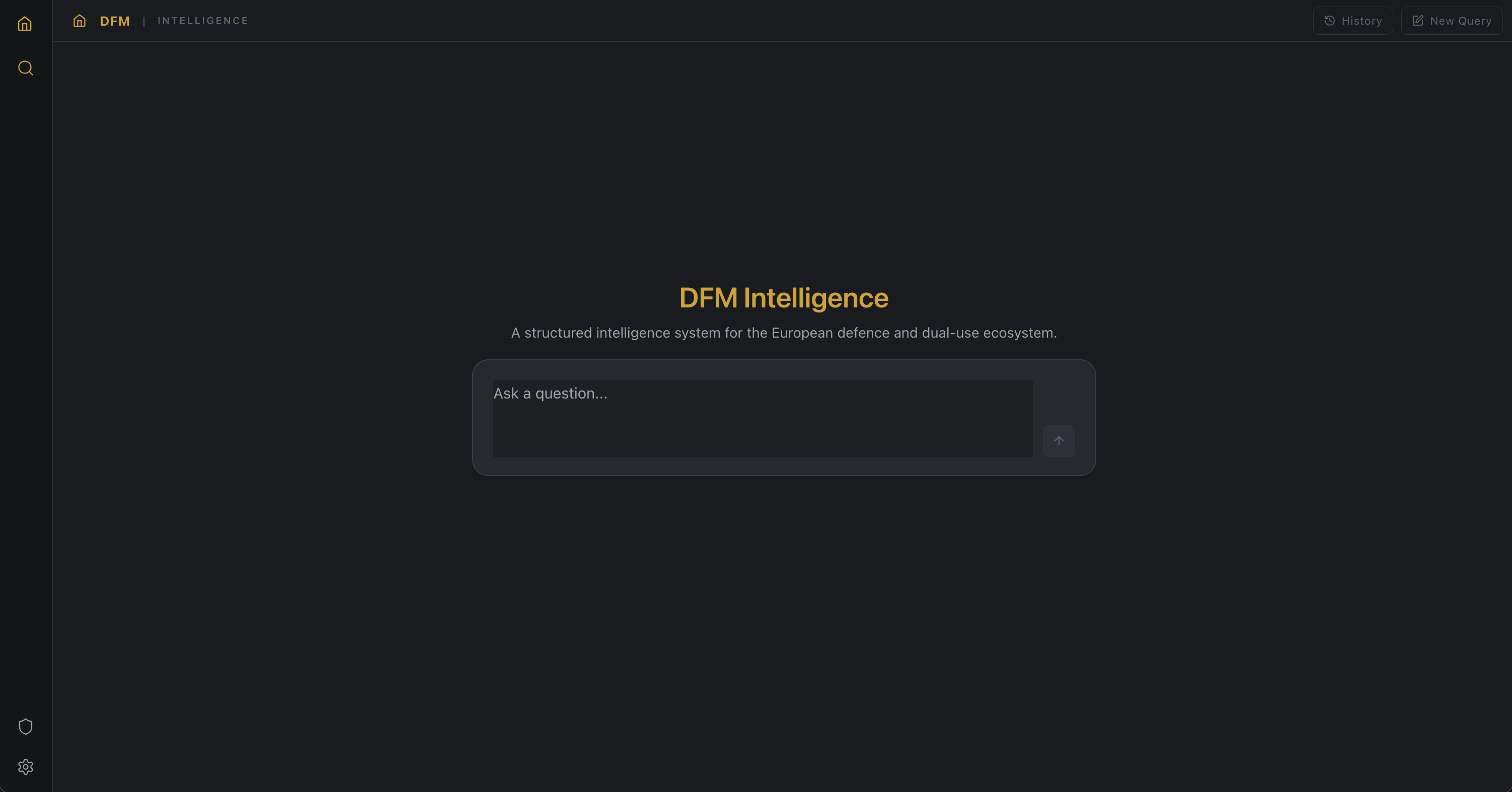
Live Query · Entry Point
System Scale · Current SeriesVerified snapshot · 2026-08-15
Classified = active records with a valid code in the closed 13-priority vocabulary. Of 2,849 monitored entity records, 2,009 are classified and 390 are in reclassification. All displayed counts are local canonical-query results, not estimates.
The System
Defence Finance Monitor is a defence intelligence infrastructure.
Its function is to return evidentially grounded, ranked responses to precisely formulated institutional questions about the European defence and dual-use domain.
01 · Function
Institutional users interrogate the system on specific analytical questions — entity exposure, supply-chain composition, eligibility conditions, capability alignment, regulatory configuration, ownership structure and funding-programme relevance. The system resolves each question and returns a structured response.
02 · Scope
Coverage extends across the European defence industrial base and the instruments that govern it: strategic priorities, operational and tactical capabilities, technology clusters, regulatory regimes, procurement records, funding programmes, ownership configurations and trade signals.
03 · Output
Every element of a response is traceable to an institutional source where the underlying record supports it. Rankings are deterministic under identical inputs. No fluency is introduced outside what the sources support.
Ontology · Taxonomy · Vocabulary · Layers
Semantic architecture.
The semantic layer is what makes heterogeneous institutional material analytically commensurable. Four components define it.
Panel 01
Closed ontology
A formal model of the domain. Thirteen strategic priority codes, fifty-three operational nodes, fifty-two tactical capabilities and twenty-seven technology clusters define the admissible entities and relations the system recognises.
Panel 02
Controlled taxonomy
A fixed classification of defence objects: entities, capability areas, technology domains, regulatory regimes, procurement instruments and funding programmes. Ingested records are normalised against the taxonomy before the analytical layer.
Panel 03
Closed vocabulary
A controlled lexicon for defence and dual-use terminology. Synonyms, acronyms, institutional references and domain-specific expressions resolve to canonical forms. Meaning is retrieved, not inferred.
Panel 04
Structured knowledge layers
Seven certified layers feed the framework — Normative, Strategic Documents, Entity and Company Data, Intelligence Reports, Research, Prime Contractor Data and Market Signals. The verified snapshot contains 27,440 atomic normative units, 1,802,619 trade-signal records and 26,284 export-control licence records.
13 priorities · 53 nodes · 52 capabilities · 27 clusters · 7 layers · 27,440 normative atoms
Method
The analytical logic.
The analytical logic rests on a specific proposition: strategic relevance, once recognised by EU and NATO instruments, becomes — over time — industrial, financial and regulatory relevance. The system is constructed to observe this translation at the point where it occurs.
Strategic signal as input
Capability plans, regulatory frameworks, procurement programmes and funding instruments are treated as structured objects. They define the capability areas, technological domains and compliance conditions that shape the operational landscape.
Derivation of relevance
From these signals the system derives operational consequences: which industrial nodes are structurally critical, which capability gaps carry funding implication, and which regulatory regimes determine eligibility. Analytical relevance is explicit and traceable to the instrument from which it originates.
Live Query · Representative Analytical Tasks
The form questions take.
The access layer is natural language. What operates beneath is constrained: resolution against the closed vocabulary, structured retrieval across knowledge layers, ranking by proprietary logic and return of a source-grounded response.
Representative outputs · Illustrative of query structure and response format
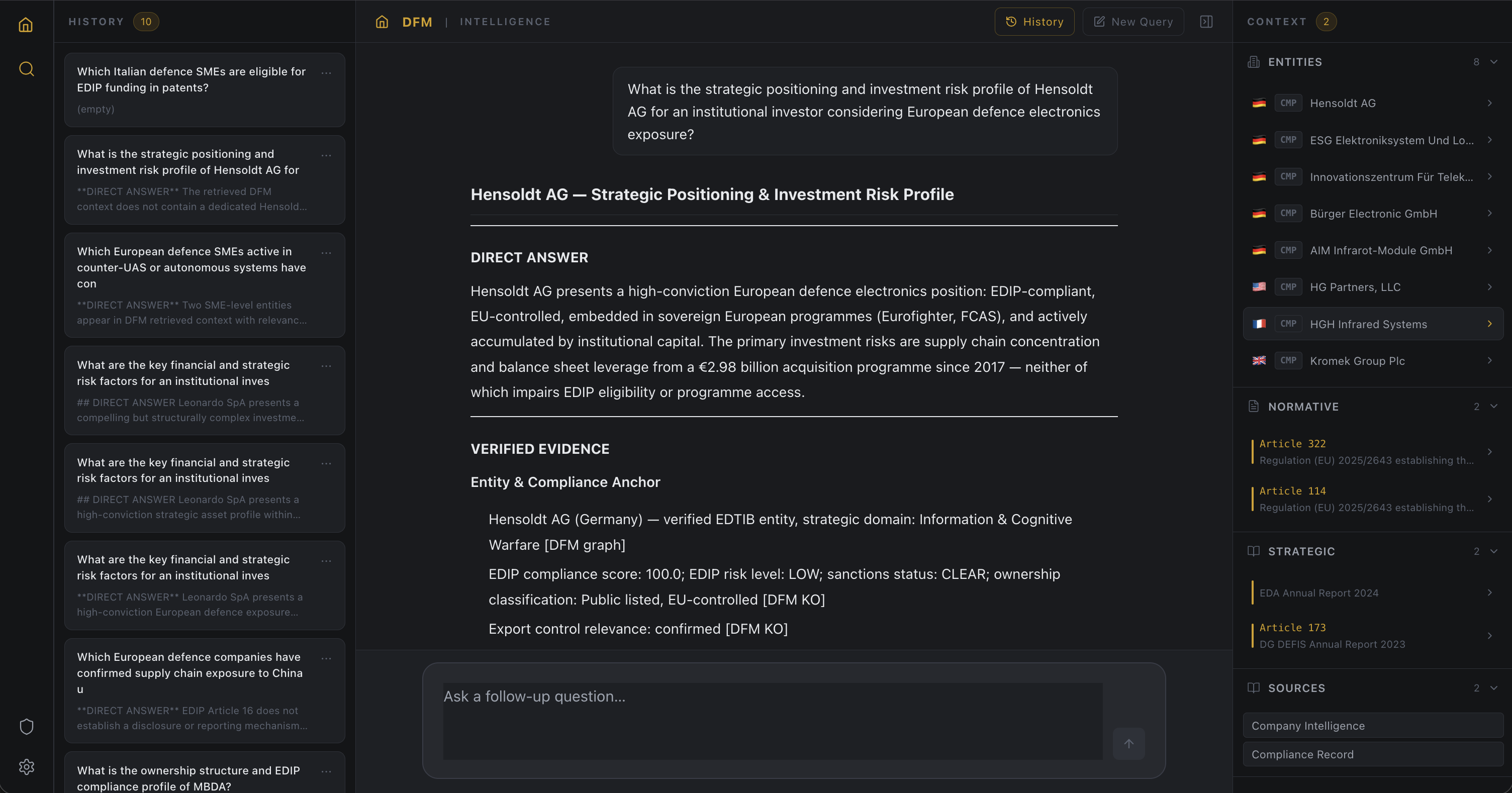
Task 01 · Finance · Exposure Mapping
Which European defence companies are most exposed to SAFE and EDIP eligibility constraints?
Entity ranking, source citations and explicit limits are returned only where the underlying evidence supports them.
Task 02 · Industry · Supply Chain
Which French tier-1 suppliers to Thales are exposed to EDIP non-compliance risk?
Source-grounded response composition combines available supplier, normative and ownership evidence.
Task 03 · Research · Funding
Which SMEs in Poland and the Czech Republic are eligible for EDF funding under priority DFM-PR-EDT10?
Programme and technology evidence remains explicit about coverage, availability and limitations.
Five Profiles · One Analytical Layer
Who the system serves.
Each institutional profile operates on the same semantic architecture, applied to a distinct analytical agenda.
Finance
Investors · Capital Markets · Credit
Structured assessment of the European defence industrial base against investment theses.
Industry
Primes · Suppliers · Deep-Tech
Positioning against EU and NATO capability priorities and technology clusters.
Institutions
Ministries · Agencies · EU Bodies
Structured observation of industrial, technological and financial signals.
Research
Universities · Labs · TTOs
Alignment of laboratory capability to recognised priorities and documented funding windows.
Advisory
Consultants · Analysts · Advisors
Institutional-grade long-listing and source-grounded analytical briefs.
Access
By invitation.
Access to Defence Finance Monitor is granted to institutional users whose analytical requirements match the system’s scope and architecture.